Friday, October 30, 2009
A fresh way to take the salt out of seawater
Wednesday, October 28, 2009
Nostalgia
I added my own list of 25 items, given below:
1. In short recess at school, those of us who had 5 paise to 25 paise pocket money enjoyed buying red-and-white bubble gum dispensed from the top of a thick bamboo. The rest of us acted as if we hated the stuff.
2. Sometimes, some of our classmates would saunter back to class minutes after the bell went off after enjoying jeera goli and having the jam-like red churan jelly smeared on our faces.
3. Some of us also enjoyed thin slices of raw mango with salt and chilli powder.
4. No Lays, no Kurkure, no bottled water. We drank straight from the tap, and had no stomach upsets.
5. No coaching classes till Class IX at least.
6. School-bags were canvas, and lasted 3-5 years. If they tore or the seams gave way, we got them repaired/stitched from the cobbler.
7. We cheerfully walked kilometres to and from school, and then, immediately after our return, went out to play.
8. Outdoor games with simple props included a variety of marble games, including one with heavy iron balls as marbles; usually we use cement marbles (3 for 10p), not glass. We also played with catapults ("catties").
9. Sparrows were more plentiful than crows and pigeons. When is the last you saw a sparrow in Bombay?
10. We still had coconut trees to climb in Bombay.
11. Our parents usually had enough money to last till the next salary, though the mind boggles on how Mom made both ends meet, what with 3-figure salaries being quite common. Yet they had enough to spare for donating for causes like cyclone relief, earthquake relief, etc. through schools.
12. Cutex nail polish, Cuticura or Ponds Dreamflower talcum powder and Tata Eau-de-cologne were the mega-cosmetics brands. Who remembers Patanwala ka Afghan Snow, regularly advertised on radio?
13. Those of us whose Dads shaved regularly saw them sporting nicks equally regularly. After-shave treatment was not lotions, but a piece of alum. Some of us had Dads who were satisfied with shaving soap or even bath soap doing double duty, to save on shaving cream. No shaving foam.
14. No computers, no video games, no playstations or wii-s. Instead, we had miniature pinball, magic "disappearing egg", and a game where we arranged numbers 1-15 by moving square pieces using the sole blank spot on a 4x4 matrix. Another one involved putting 5 tiny iron balls into the innermost concentric circle all at a time.
15. We played barefoot, or at most, with chappals. No sneakers, walking shoes and running shoes.
16. The area around the apartment buildings was open -- hardly any cars were parked because very few people had cars.
17. There were at least a few bungalows/ independent houses in each locality in Bombay. They have all but disappeared in Bombay.
18. No swimming pools (except municipal), no basements. Some enclosed garages so you could lock your car out of sight of your envious neighbours' eyes.
19. 100% cotton was much cheaper than terry-cot or synthetics; and we hardly had ready-mades. Everyone had a fixed, favourite tailor.
20. Ready-made Shirts made of cotton gauze (!!) (fashionably called cheese-cotton) were available at Handloom House in Mumbai (since burnt down).
21. Clothes with multiple colours that ran -- "bleeding madras", I think it was called, were also in fashion.
22. Who can forget "double-knit" pant pieces smuggled from Japan sold by the neighbourhood tout?
23. Radio mostly meant Vividhbharati, Bombay A or Bombay B on Medium Wave.
24. Sunday morning 11 am was Bournvita Quiz Contest time on Vividhbharati, with Hameed Sayani, and after his death, Ameen Sayani compering the show. The timer's tick-tock still rings in my ears, and we had great fun when we knew the answer, but the team on radio did not. We kept repeating it, till we were told the answer -- as if they could hear us!
25. Listening to Voice of America or BBC Radio when conditions were just right, at night on shortwave, was another treat.
Monday, October 26, 2009
My experience at the Passport Office, Thane
Then, a week after I had applied (not tatkal; ordinary class), I found my lost passport. So I wanted the process of issue of new passport to be cancelled. This was an exception process, and I expected it to be a bit of heavy weather. I was surprised there, too.
I enquired at the enquiry counter (there was a queue there too, but I was early, so it did not trouble me). I was directed to meet the Asst Passport Officer in a particular cabin. The Officer concerned (R Vijaykumar) was exceedingly soft-spoken and polite. I saw that he treated everyone the same way. He told me that he would have to check the status of my application; if it was already marked on their record as lost, then I would have to address to him a letter along with my old passport, and request that both passports (old and new) be returned, so that the visas in the old one remained valid. Else, he would cancel the process.
As it turned out, even though it was barely a week since the application for new passport was filed by me, the passport had already been marked as lost on their record, so I submitted the letter and got an acknowledgement on a copy thereof, and was out of the office in little over than 90 minutes, including the time to procure blank paper, write the letter, photocopy it, etc..
I now am looking forward for this process to smoothly complete without any hitch.
India is on the move, and I am proud to be an Indian. I am proud to say that at least some Government departments are getting more efficient and less corrupt.
Monday, October 19, 2009
Shocking -- Rape Victims Denied Recourse to Court in the USA
Republicans are opposing an amendment to deny government contracts to companies that force their employees to accept binding, mandatory arbitration; i.e., forgo their right to go to court, including, inter alia, women who are alleging that they have been raped, assaulted, etc.. Why is such a salutary provision being opposed? Because the companies that would be hurt the most would be Halliburton and KBR, the contractors who have got uncounted billions worth of US taxpayers' moneys to support the American wars in Afghanistan and Iraq. It has come out that several women have alleged gang rape by male employees of these contractors, and all these cases have been hushed up by the mandatory binding arbitration. See this devastating cross-questioning of a KBR attorney by a Sen Frank Allen.
It is difficult to believe that in a country that prides itself on upholding human rights that this can be allowed to happen.
It has taken 10 years of war for this state of affairs to emerge into the public domain in any meaningful way other than armchair discussions.
Friday, October 16, 2009
Some advice I gave today
Exchanged email with a young girl, who is still in her first job, and was a colleague a few years ago. She showed very good command over English in her brief emails.
She had given up her pursuit of a Masters degree in her discipline, and had stated on another PG degree. I thought she was a bit too casual about her career choice, so I gave her some unsolicited advice. I wrote:
Wednesday, October 14, 2009
IPR takes centrestage in WTO dispute on cotton subsidies
The developed world is learning that the legal framework supporting and honouring the western IPR regime in a developing country cannot be taken for granted.
Brazil has been permitted by the WTO to retaliate against the injustice done to their cotton farmers by the generous subsidies doled out by the US to their cotton farmers, making it possible for them to undercut and underprice the cotton. And what form is this retaliation taking? Not new anti-dumping on US imports, or trade embargoes.
Brazil has been permitted to allow their country's pharmaceutical companies to manufacture medicines in Brazil in deliberate violation of patents held by US companies. This one is a below-the-belt hit for the vibrant US pharma industry. Brazil is a huge market, and very lucrative too. All the lucre will disappear overnight in their Brazilian operations, if this were allowed.
This is very unfair, or very fair, depending on your point of view.
For US companies, it will seem very unfair, because, for no fault of theirs, they are losing patent protection in a lucrative, large market (there aren't too many of those nowadays!).
However, Brazil, and most of sub-Saharan Africa, which includes really poor countries like Chad, Mali, Liberia and Burkina Faso, will be cheering. They have cotton they cannot sell thanks to under-priced US cotton flooding international markets; they don't have factories that can add value to the cotton; and they have huge AIDS affected populations. Their cotton farmers and the AIDS patients will like the prospect of better times ahead.
Monday, October 12, 2009
Nobel for Obama -- Definitely Premature; Possibly Immature
First, for sure, the Nobel Committee has lowered the prestige by choosing an awardee based on hope for what he could do, than what he has actually done.
Second, it is a travesty of the original intent of the Prize -- the Commander-in-Chief of an army that is involved in two high-profile, high-casualty wars, is rattling sabres against yet another state (Iran), and is continually complicit and involved in the happenings in Israel/West Bank/Gaza and Pakistan, other nations not at peace, is awarded the Peace Prize. And how do they conduct the wars? They have minimal on-the-ground presence, but pummell people who they call "insurgents" and "the enemy" on defenceless people on the ground, using unmanned drone aircraft.
Third, the decision is the result of Groupthink, I am sure. I doubt if, privately, any of the Nobel Committee members agrees about the award, though they decided otherwise in the Committee.
Nothing's changed!
He indicated that he would move back to his roots -- UK -- if he does not get his dues, because the whole of America is balking at paying his eye-popping profit-share in commodities trading. So guess what, Citi has sold off Phibro rather than handle the controversy and embarrassment of paying him $100Mn when they still haven't repaid the Government bailout money. Now, Occidental Petroleum, the buyer, will have to handle the embarrassment. He's that valuable! Is he, really??
True, his bets have gone right much more than they have gone wrong. What if they had failed? Would his employer be able to claw back the losses from his past pay?
The inability to rein in "star traders" such as Hall and "star-CEOs" is one of the biggest continuing governance failures that the developed world has still to get its hands around.
Tuesday, October 06, 2009
Article on Geographical Indications in Business Line
Please see my article in Business Line on Geographical Indications, a form of Intellectual Property Protection, published in the Opinion Section in the Issue dated 3rd October, 2009.
My articles in Business Line Opinion Page
Moral hazard and its harmful role in credit market crisis (July 23, 2008)
Monday, November 10, 2008
Credit Default Swaps should not be banned, says the Economist
"CDSs have their uses. There is no reason why investors should not speculate in corporate debt if they can speculate on equities, currencies, commodities and the rest."
Famous last words, don't you think?
Second thoughts on Lloyd's TSB-HBOS merger
Credit Default Swaps
Jayanth Varma of IIM, Ahmedabad, draws atention to the fact that the Depository Trust and Clearing Corporation of the US has published what is perhaps the first comprehensive official numbers on the global credit default swap market, including the top 1000 reference names, that account for over 95% of the market by gross notional value and a little less than 90% by net notional value.
Global gross notional exposure is $15.38 Trillion and Net notional exposure is $1.76 Trillion.
There are 4 Indian-owned entities in this list (ICICI, Reliance Industries, State Bank of
Suggestions for a healthier debt market
Tuesday, March 27, 2007
Business Ethics Training
Monday, November 06, 2006
Corporate Failures: Tyco International Ltd
Tyco International Ltd. made several products, from healthcare supplies to electronic and plastic adhesives. It accused three former high-level executives to have entered into a fraud. The three accused managers were former CEO L. Dennis Kozlowski, former Chief Financial Officer Mark Schwartz, and former general counsel Mark Belnick who have since been indicted for fraud and theft by the Securities and Exchange Commission (SEC) as well as their former employer.
Both, the SEC and Tyco International indicted the former executives on charges of civil fraud and theft. They were accused of giving themselves interest-free or low interest loans for personal purchases of property, jewelry, and other frivolities. According to the SEC and Tyco, these loans were never approved or repaid. These former high-level executives were accused for the following reasons:
1. Waiver of Loans to employees and themselves:
Kozlowski and Schwartz were accused of issuing bonuses to themselves and other employees without approval of Tyco’s Board of Directors. These bonuses in effect acted as de facto loan forgiveness for employees who had borrowed company money or were used to buy the silence of those who suspected the former CEO and CFO of fraud. The individuals who received loan forgiveness said that they were not aware that they were participating in anything illegal; they were told the program had the board’s approval. Tyco and the SEC say it did not.
After an internal investigation into the matter by Tyco, it was revealed that 11 out of 51 Tyco employees were discharged from the liability of repaying loans at Kozlowski's direction and without board approval. This amounted to $56 M in bonuses that in effect canceled out loans they had taken from the company's relocation program, adopted in 1995. This went to such an extent that in addition to waiving the loan repayment, extra money was provided to reimburse them for the tax consequences of the loans.
How did it happen?
Kozlowski, issued a memo in September 2000 to an HR officer that the board had approved more than $95 million in forgiving loans to employees, even though it hadn't. Kozlowski told Patricia Prue, Tyco's Senior Vice President, HR, that the loan forgiveness payments were meant as a bonus for their good work. In turn, Prue also received a forgiven loan of about $1.3 M.
Mark Foley, a vice-president of finance, prepared a memo signed by Schwartz, that showed the company would include the expense as part of other charges, rather than account for the loans individually as employee compensation.The total payout from the program was $96 M, of which Kozlowski received $33 M and Schwartz $16.6 M.
2. Selling of Company Shares:
Kozlowski, Schwartz, and Belnick were also indicted on charges of selling their company stock without telling investors, despite their obligation to do so under SEC rules. In sum, the three are accused of stealing $430 M dollars from Tyco International.
3. Misuse of Company Funds:
Kozlowski used company’s funds for personal expenditures, including a $15,000 umbrella stand, $97,000 for flowers and $2,900 for coat hangers. Some of the furnishings that lacked any "legitimate business purpose" included a $17,100 traveling toilet box; a $6,000 shower curtain; and $2,200 gilt metal wastebasket.
The company said Kozlowski misused $62 million of the company's coffers to purchase a $16.8 million apartment on Fifth Avenue in New York and $14 million for improvements and furnishings to the apartment. The executives lived lavish life on the company’s funds.
4. Avoiding sales tax on paintings:
Kozlowski bought roughly $13 million in paintings and was charged with conspiracy, tampering with physical evidence, falsifying business records and sales tax violations. The paintings included "Fleurs et Fruits" by Pierre Auguste Renoir and "Pres Monte Carlo" by Claude Monet.
How did it happen?
Kozlowski and his coconspirators generated false documents, such as invoices and shipping documents, to make it appear as though the artwork was to be shipped out of state and therefore not covered by New York state sales tax provisions. In order to thwart tax auditors, Tyco employees were directed to sign false documents reflecting the receipt in New Hampshire of artwork.
Kozlowski actually shipped empty boxes out of state and had an art consultant remove a $425,000 painting from his $17 million duplex apartment at the corner of 76th Street and Fifth Avenue and ship it to Tyco offices in New Hampshire. There, an employee allegedly signed for it before it was immediately returned to Manhattan and reinstalled in the apartment.
How was it revealed?
Kozlowski's downfall started in early January, 2002, when Irwin Nack, an investigative counsel to the superintendent of the New York State Banking Dept., came across a series of bank transfers that struck him as highly unusual. Within few days, a number of transfers had moved into the bank account of high-end Manhattan art dealer Alexander Apsis. From there, they were quickly moved to offshore accounts. Morgenthau had put 6-8 people on the Kozlowski case full-time, including investigators, analysts who specialize in economic transactions and financial records, lawyers, and paralegals.The team worked all summer examining subpoenaed documents, e-mail, and financial statements -- and built a much larger case against Kozlowski and other Tyco executives. It accused the former CEO and CFO Mark Schwartz of taking $170 M out of the company and pocketing $430 M more in tainted stock sales. From one small suspicion grew one of the biggest white-collar cases in history.
Wednesday, October 25, 2006
How to "remove" words from a spell-check Dictionary
1) Create a new document in Word. (or you can use the Notepad for this)
2) Add each word for your exclusion dictionary on a separate line.
3) This file must be saved as a text only file type so if using Word, use File/Save As and change the file type to Text Only (*.txt)
4) Locate folder for your main dictionary (*.lex) and name the file using the same name as your main dictionary but with an .exc file extension.
Typically, the main dictionary is located in the \Microsoft\Proof or \Microsoft Shared\Proof folder, but you can also use Start/Find/Files or Folder and search for *.lex.
The name of the dictionary depends on the language and version of Office that you are using. For example if using English (United States):
Main dictionary:Word 97: Mssp2_en.lexWord 2000: Mssp3en.lex
Exclusion Dictionary:Word 97: Mssp2_en.excWord 2000: Mssp3en.exc
You may need to restart Word after doing this for the exclusion dictionary to be recognised.
A useful "Easter Egg" in Word
Very often, when we are creating templates, we need running text to check (for example) the number of lines that fit on a page. We might also need text to get a feel of how the whole page will look like when text is filled in. An easy way of inserting dummy text for such purposes is described below.
If you key '=rand()' (without the quotes) and press Enter, you will get 3 paragraphs, 3 sentences each of 'The quick brown...'. If you insert 5,10 between the parentheses, you get 5 paras, 10 sentences each of the same text.
I would be glad to attribute this to the person who told me about it, but I learnt it so long back, that unfortunately I am unable to remember.
Thursday, October 19, 2006
Have you seen Open Office lately?
This comparison exercise needs to be done again. My old list is given below. Remember, this compares version 1 of Open Office with Office XP.
1. It is free (www.openoffice.org). Windows version is a 50 MB download. Linux and Mac versions are also available.
2. It is in at least a few ways one-up on Word 2002. Some of these are listed below:
- Supports CMYK as well as RGB colour
- Has ability to define a heirarchy (classification) of styles in a template to classify styles for easier access
- Has ability to anchor objects to even a character or page and not just a paragraph
- Allows you to insert and run Java Scripts or the URLs where the scripts are available, at any location in an HTML document
- Allows you to enter References directly into a bibliographic database and call them in a document, now separately available as third party plug-ins to MS Word
- Has its own fairly sophisticated WYSIWYG Math Editor comparable to MathType which is a separate, paid Add-in for MS Word
- Allows part of a document to be designated at Read Only
- Can hyperlink document content to a particular e-mail
- Can assign “Ruby text” (a pronunciation key) to selected Asian language text and specify alignment of ruby text separately
- Search and Replace facility can allow searching for Widows or Orphans
- Style definition flexibility is considerably superior to MS Word. Consider what Style definition permits in Open Office:
- Different specification for Widows and for Orphans
- Separate fonts for Asian and for Latin Text characters, which is not available in Word 2000 but is available in Word 2002. Specifying how many characters permissible before and after hyphen, in addition to hyphenation zone
- Many more styles of underlining than MS Word
- Font in embossed and engraved effects besides shadow
- Placing special emphasis characters above or below each character of style
- Superscript and subscript sizes and positions to be varied as percentage of normal font sizes
- Creation of decimal aligned tab to align at a comma or any other character by treating it as the decimal character
- Setting a grid for a Reference style and for the base line of another style to snap to the grid of the reference style.
- Alignment of characters of para to base or top where a few characters in a paragraph are in significantly larger font than others.
3. It is quite programmable because
a) It has its own answer to Visual Basic
b) it can translate VBA macros in existing Word files into its own version of Basic and
c) It also supports programming in Java.
d) I haven't tested out the programming languages and features and hence cannot comment on how good or bad they are.
4. It has a "developer version" and the source code of each version also available for download.
5. It can open any version of MS Word or RTF, or MS Excel files, and also save in any MS Office format.
Microsoft Word Trick
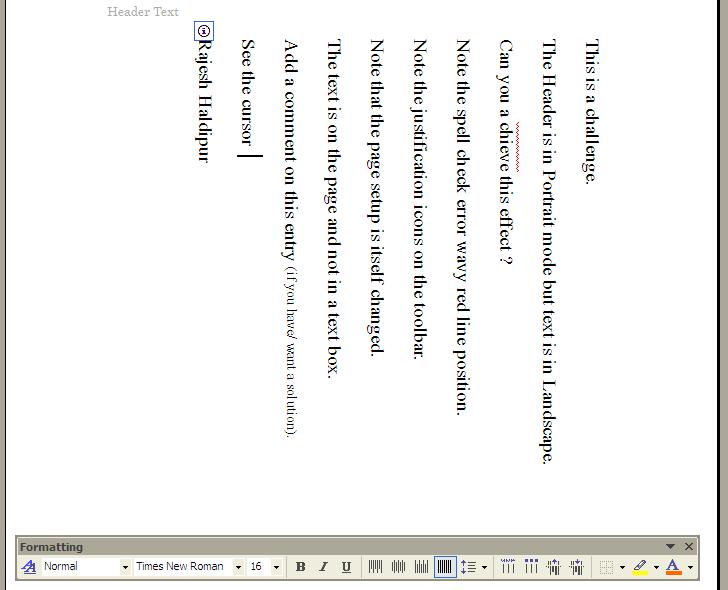
Have you ever wanted to have portrait headers and footers on a page that has text or tables running in landscape mode, or vice versa? See the screen capture.
Note carefully the smart tag icon, the justification icons on the toolbar and the cursor in the picture.
Do you understand how this effect is achieved ?
The page setup is itself changed.
The text is on the page and not in a text box.
The Header is in the Header pane.
Add a comment if you know or want the solution to this challenge.