.
Recently, the guy who wallpapered my office told me that the gum they use is CMC powder mixed with water. CMC powder is also used in making icecream; and since he came to know of that, he has stopped eating icecream!
50 grams of CMC diluted by more than a full bucket of water made enough gum to wallpaper the entire office!
More on CMC powder is available here - it is a man-made gum with the technical name Sodium Carboxymethyl Cellulose Gum. A companion piece on artificial strawberry flavouring - you can read here. And a little more about milk.
We eat so many chemicals that our bodies don't even decompose fast enough after burial. See this article.
Saturday, April 30, 2011

The Murky Business of Sovereign Ratings
.
Feb 2011 ratings show United States and United Kingdom at Ranks 15 & 16, with India at Rank 56. Norway and Switzerland are at the top of the table (no surprise here). The surprises are Italy (30th) (Its debt is 116% of GDP! Its financial mess is well known), Spain (34th), Ireland (43rd) (which has asked for a bailout package from IMF in Nov 2010), Iceland (46th) (which went bankrupt and has twice refused to bear losses of their private banks in 2008) and Portugal (44th) being ahead of India. Greece is the only one out of the so-called PIIG countries that is below India (65th). One can quarrel with these ratings, but I suspect that won't help much. More ...
Sunday, April 24, 2011
Sathya Sai Baba departs
.
Expect some sleazy stuff of palace intrigue and financial misdoings to come out, now that Sathya Sai Baba has departed, leaving no clear successor or succession plan, but huge wealth and assets meant for public charity. The rumbles began even as the Baba was on his deathbed.
One prosaic, non-spiritual lesson we can learn from this is, WRITE YOUR WILL. Howsoever rich or poor you are. So that your heirs do not fight or do not have too much trouble with paperwork where nominations are not recorded, or where property title deeds are mortgaged, or where your property may need to be sold in order to share proceeds.
.
Expect some sleazy stuff of palace intrigue and financial misdoings to come out, now that Sathya Sai Baba has departed, leaving no clear successor or succession plan, but huge wealth and assets meant for public charity. The rumbles began even as the Baba was on his deathbed.
One prosaic, non-spiritual lesson we can learn from this is, WRITE YOUR WILL. Howsoever rich or poor you are. So that your heirs do not fight or do not have too much trouble with paperwork where nominations are not recorded, or where property title deeds are mortgaged, or where your property may need to be sold in order to share proceeds.
.
Friday, April 15, 2011
Linux at 20, and My Personal Experience
.
Linux has turned twenty, though there might be more than one known "birthday".
A few months back, I moved my whole office progressively to Linux. 84% have Ubuntu and the rest have Fedora. Since then, I have moved almost everything to Linux and OpenOffice, StarOffice or LibreOffice (I have all three whose files are perfectly interchangeable.
Recently I read with pleasure the following paragraph:
Linux runs everything from air traffic control systems to infotainment systems to nuclear submarines. Linux also powers the $10-billion CERN super collider, the special effects in Avatar. Zemlin also pointed out that Linux-powered stock markets now trade “72% of the world’s equity trades in 2010.” This, I might add, was before the London Stock Exchange went to Linux earlier this year. And of course, there’s been a “complete inversion” in supercomputing. In ten years, the top 500 supercomputers have switched from 96% Unix to 96% Linux. (taken from here).
Looking back, I think I made the right decision. I had hardly any teething troubles, got my assembled OS free machines much cheaper, and now my employees actually prefer Linux because of its speed and its cool graphics. They also regularly raid the Ubuntu software store and use nifty little and large applications for a variety of purposes. We have a script that automatically backs up contents of each machine in the office, including the Windows partition on 2 hard disks, onto a 2TB hard disk every day between 10 am and 12 noon.
Large part of the thanks for this transition are due to Nandan Bhat who runs Linux-based certification training courses from Novell and Red Hat in my city. My only gripe is that our heavy-duty printer, a scanner-cum-printer from Canon, has a Linux driver that for some reason does not work. So occasionally, for long print jobs, I need to switch one machine to Windows.
.
Linux has turned twenty, though there might be more than one known "birthday".
A few months back, I moved my whole office progressively to Linux. 84% have Ubuntu and the rest have Fedora. Since then, I have moved almost everything to Linux and OpenOffice, StarOffice or LibreOffice (I have all three whose files are perfectly interchangeable.
Recently I read with pleasure the following paragraph:
Linux runs everything from air traffic control systems to infotainment systems to nuclear submarines. Linux also powers the $10-billion CERN super collider, the special effects in Avatar. Zemlin also pointed out that Linux-powered stock markets now trade “72% of the world’s equity trades in 2010.” This, I might add, was before the London Stock Exchange went to Linux earlier this year. And of course, there’s been a “complete inversion” in supercomputing. In ten years, the top 500 supercomputers have switched from 96% Unix to 96% Linux. (taken from here).
Looking back, I think I made the right decision. I had hardly any teething troubles, got my assembled OS free machines much cheaper, and now my employees actually prefer Linux because of its speed and its cool graphics. They also regularly raid the Ubuntu software store and use nifty little and large applications for a variety of purposes. We have a script that automatically backs up contents of each machine in the office, including the Windows partition on 2 hard disks, onto a 2TB hard disk every day between 10 am and 12 noon.
Large part of the thanks for this transition are due to Nandan Bhat who runs Linux-based certification training courses from Novell and Red Hat in my city. My only gripe is that our heavy-duty printer, a scanner-cum-printer from Canon, has a Linux driver that for some reason does not work. So occasionally, for long print jobs, I need to switch one machine to Windows.
.
Wednesday, April 13, 2011
Google out-googled - and that too by an Indian company!
.
Google features quite often in this blog for all the interesting things it does. However, here is an offering that out-googles Google - and that too, on GMail and Google Apps! What's more, this quiet, really useful product (you will really be missing out on something if you don't check this out) has been developed by an Indian company, headquartered, where else, but in Bangalore! More ...
Google features quite often in this blog for all the interesting things it does. However, here is an offering that out-googles Google - and that too, on GMail and Google Apps! What's more, this quiet, really useful product (you will really be missing out on something if you don't check this out) has been developed by an Indian company, headquartered, where else, but in Bangalore! More ...
Tuesday, April 12, 2011
Libyan Mess: The Awkward Position Obama Finds Himself In
.
Why does a woman agree to sleep with a known serial womanizer? Because she naively believes that she will be the woman who will cure the poor man of his womanizing ways.
Why does a leader of a republic wedded to democracy attack nations run by despots? Because he believes (whether naively or not) that he will be the one who can liberate the poor (actually rich!) country from the despot, and introduce a happy-ever-after democracy. More ...
Why does a woman agree to sleep with a known serial womanizer? Because she naively believes that she will be the woman who will cure the poor man of his womanizing ways.
Why does a leader of a republic wedded to democracy attack nations run by despots? Because he believes (whether naively or not) that he will be the one who can liberate the poor (actually rich!) country from the despot, and introduce a happy-ever-after democracy. More ...
Friday, April 08, 2011
The NDM Virus controversy is back!
.
The recent controversy over the NDM-1 bacterium a.k.a "superbug" is important - any drug-resistant infection needs to be stamped out, wherever in the world it occurs. So while I am not suggesting that the findings of the researchers are wrong, I am suggesting that the focus on New Delhi and India almost exclusively is as a result of a deep game played by Big Pharma.
Naming the bacterium after New Delhi and conducting follow-up surveys, taking samples surreptitiously from the Indian sub-continent, and warning the rest of the world about this "superbug" from India is an insidious game being played by Big Pharma to detract attention from the fact that the same bacterium was discovered being repeatedly introduced into the UK from the US and 3 other European countries, before it was discovered in a Swedish patient transiting India en route to the UK. Given below is this story, which no newspaper has so far written about. More ...
The recent controversy over the NDM-1 bacterium a.k.a "superbug" is important - any drug-resistant infection needs to be stamped out, wherever in the world it occurs. So while I am not suggesting that the findings of the researchers are wrong, I am suggesting that the focus on New Delhi and India almost exclusively is as a result of a deep game played by Big Pharma.
Naming the bacterium after New Delhi and conducting follow-up surveys, taking samples surreptitiously from the Indian sub-continent, and warning the rest of the world about this "superbug" from India is an insidious game being played by Big Pharma to detract attention from the fact that the same bacterium was discovered being repeatedly introduced into the UK from the US and 3 other European countries, before it was discovered in a Swedish patient transiting India en route to the UK. Given below is this story, which no newspaper has so far written about. More ...
Monday, April 04, 2011
Google's mother-of-all business model
.
Google makes its money from search. We all know that. But how many of us know the crushing blow that Google is delivering to several small and big companies in several industries? We are not speaking of the rude shocks that thousands of small businesses get from displacement from their usual place in search listings when Google tweaks its search engine algorithm. More ...
Google makes its money from search. We all know that. But how many of us know the crushing blow that Google is delivering to several small and big companies in several industries? We are not speaking of the rude shocks that thousands of small businesses get from displacement from their usual place in search listings when Google tweaks its search engine algorithm. More ...
Friday, April 01, 2011
The Libyan Mess: An American Opinion Leader's Viewpoint
.
What I have feared in earlier blog posts - that US involvement in Libya is ill-considered and can turn into another Iraq - is coming true much, much quicker than I feared.Look at this. A real mess is in the making!
.
Google Public Data Explorer: Now visualize your own data in 3D for free!
.
In May, 2010, I had commented about the Google Public Data Explorer. At that time, I had said that the next step would be to allow users to upload their own datasets to take advantage of this excellent visualisation engine.
This has now happened. See this. At last, I am happy that something really good that I predicted has come to pass.
You can now use this great visualization engine to display your own data in three dimensions, with the third dimension being time.
.
In May, 2010, I had commented about the Google Public Data Explorer. At that time, I had said that the next step would be to allow users to upload their own datasets to take advantage of this excellent visualisation engine.
This has now happened. See this. At last, I am happy that something really good that I predicted has come to pass.
You can now use this great visualization engine to display your own data in three dimensions, with the third dimension being time.
.
Friday, March 25, 2011
Did you know that ...
.
Almost every aggressor-country in the War of Libya has been consorting or hobnobbing with the despots ruling Arab countries that have been experiencing huge political upheavals? More ...
Almost every aggressor-country in the War of Libya has been consorting or hobnobbing with the despots ruling Arab countries that have been experiencing huge political upheavals? More ...
Thursday, March 24, 2011
Are Web Apps the Next Big Thing?
Nowadays, everyone and his dog seems to be extolling the virtues of web apps. Examples:
- iPod first created the concept of an “ecosystem” built around a product, with integration with iTunes. They followed it up with iPad and a huge App Store to go with it.
- MS Office 2010 buyers get free online applications of Office that run under most browsers. This is a significant “webification” of MS Office 2007 which transitioned from creating binary objects to XML objects for the first time.
- Google's Chrome browser has created a Web Store and several of the apps available on it (I have only checked some of the Free ones) are stunning. The browser now reads PDF files natively without need for a PDF reader plug-in.
- The Chrome browser will eventually become the OS itself – where you directly boot up and go online. The browser is the OS.
- Splashtop offers a Linux OS of that kind, with a difference – it is is installable like any Windows app, from within Windows (indeed, that is the only way you can install it), and offers a quick boot option that actually boots and goes online in 10 seconds on many machines.
- Much electronic ink is being expended on whether Firefox will survive or not, revolving around the preesence or absence of its App strategy.
- The CEO of Nokia, in his now famous “burning platform” email to Nokia employees, says that Nokia failed to see the “ecosystem” concept that Apple, Android and others were building around mobile handsets, and lamented that Nokia tried to replicate feature after feature, but not the ecosystem. It's Ovi Store is an attempt to catch up.
Tablet PCs were touted as the rage a few years back (Gates demo-ed a device running Windows XP Tablet PC Edition at Comdex in 2001), but flopped. So did e-book reading hand-held devices like Treo, Palm, et al, that were PDAs and e-book readers but not phones. Both these concepts were a little ahead of their times, so today, e-book readers like Kindle and Nook and hand-held tablet PCs have become the rage. Smartphones like Blackberry and iPhone have e-book reading apps pre-loaded, or downloadable free.
For some time, now, Google has been evangelising the idea of storing and depending more and more on “the cloud”, but it will be some time before people learn to depend completely on the cloud, to the exclusion of local access and storage. The same way that news reports that the Nano caught fire has deterred many potential Tata Nano buyers, I am also a little cagey on reading recently that some 150 users of Gmail had the entire content on their Gmail account deleted. What if I was among those 150? A simple hard disk crash is something we have learnt to take in our stride, using the redundancy in the form of cloud storage plus regular local backups and redundant copies. But what is the alternative in the cloud? Is there redundancy ? How can it be affordable? Now it is free, but for how long? These are concerns everyone has, and until these are taken care of and seen to be taken care of, web apps will not become universal.
So, while I think the concept of web apps will take off finally, currently, the apps are curiosities that early adopters are adopting; to accelerate that into a burgeoning “movement” where all will migrate to web apps will take many many more adopters. I can see it happening in 3-4 years from now, but not now. Now, many will begin co-opting “the cloud” into their redundancy plans, for non-secure data.
What do you think?
.
Sunday, March 20, 2011
Why is the War of Libya being fought?
.
We think it is a war between the rich nations and a despot ruling a poor African country, in order to free them from, among other things, economic hardship. Right?
What is a rich country? A country whose income is far in excess of its spending. That is how we define a rich man, right? A man who earns more than he spends, by a wide margin?
A good proxy for that at the country level is Current account balance (Percent of GDP)
Look at the table below: It is a report from the IMF's World Economic Outlook database, October 2010 edition.

Guess what? All the countries in the list are those who are actively fighting in the early part of the war in Libya. It clearly shows that Libya is the rich guy; and all the others are the poor guys, who are spending in excess of their incomes! For the last 3 years, and were it not for the war, that is what would be happening next year too, according to IMF estimates.
Not fair, you may say. What you should look at is the net indebtedness of the country, as a percentage of its GDP. That is a true indicator of who is rich, and who is not. Let us look at that, then, from the same source.

Guess what? You're right! Libya, again, is the richest among these countries - it had positive forex and gold reserves (not net indebtedness) to the extent of 88 to 100% of its GDP ! Indeed, Italy is getting as poor as Libya is getting rich by this definition, for the last 4 years!
But then you may say, what we need to see is whether the citizens of the countries are becoming richer or poorer; not whether they are rich or poor.

Surprise!! The average Libyan is getting richer (except in 2009 when international oil prices dipped) and citizens of all the other countries seem to be getting poorer, over the last 4 years.
No, you might say, is the country growing or not? And which country's economy is growing faster? That is a good indicator of economic well-being.
Yet again, it is Libya that comes out on top, with an estimated 10% rise in GDP in 2010.
We think it is a war between the rich nations and a despot ruling a poor African country, in order to free them from, among other things, economic hardship. Right?
What is a rich country? A country whose income is far in excess of its spending. That is how we define a rich man, right? A man who earns more than he spends, by a wide margin?
A good proxy for that at the country level is Current account balance (Percent of GDP)
Look at the table below: It is a report from the IMF's World Economic Outlook database, October 2010 edition.
Not fair, you may say. What you should look at is the net indebtedness of the country, as a percentage of its GDP. That is a true indicator of who is rich, and who is not. Let us look at that, then, from the same source.
Guess what? You're right! Libya, again, is the richest among these countries - it had positive forex and gold reserves (not net indebtedness) to the extent of 88 to 100% of its GDP ! Indeed, Italy is getting as poor as Libya is getting rich by this definition, for the last 4 years!
But then you may say, what we need to see is whether the citizens of the countries are becoming richer or poorer; not whether they are rich or poor.
Surprise!! The average Libyan is getting richer (except in 2009 when international oil prices dipped) and citizens of all the other countries seem to be getting poorer, over the last 4 years.
No, you might say, is the country growing or not? And which country's economy is growing faster? That is a good indicator of economic well-being.
Yet again, it is Libya that comes out on top, with an estimated 10% rise in GDP in 2010.
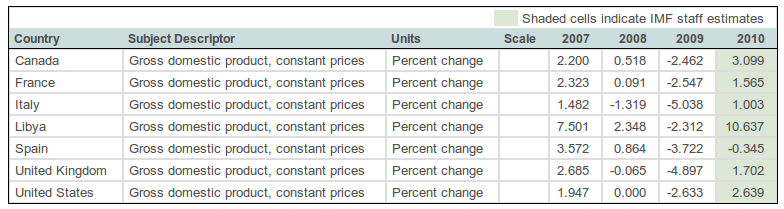

So, is it the rich countries that are ganging up against one poor country, or are the poor countries ganging up to impoverish one rich country? Think Again! The evidence shows that poor countries full of rich people (ie, with high per capita incomes) who covet the neighbour's wealth (oil reserves), are going to war, to distract attention to the state of their economies.
The War of Libya, 2011 is underway
.
It bears striking similarities with the US invasion of Iraq in 2003. A long-standing despot; international condemnation; soothing noises made by the despot when attack looked imminent. Only one difference: The UN Security Council has actually authorized implementation of a no-fly zone. In case of Iraq, the UN stopped short of authorizing entry. This resolution is the fig-leaf. Under cover of this resolution, the NATO and US forces will not stop short of doing anything to ensure “regime change” - doublespeak for killing Gaddafi. It will begin, almost certainly, with “decapitation” attacks aimed at eliminated Gaddafi, right at the start. The strategic justification is “elimination of command and control”. Then, there will be invasion, and finally occupation. Till here, things will move exactly as planned by the NATO forces. Of course, a few hundred civilians will perish for no fault of their own, especially likely in Benghazi, the rebel stronghold.
Libya is a huge country - the 17th largest in area, though relatively sparsely populated (less than 6.5 Mn), with barely 1% of its land area being arable and under cultivation - it therefore imports almost 90% of its food. Its oil riches, however, have given it one of the highest per capita GDP in Africa. Libya has the 14th highest reserves of foreign currency and gold in the world.
One must remember that till now, Al Qaeda has not managed to make major inroads into Libya because Gaddafi did not allow it in his own self-interest. Gaddafi attributed the unrest in Libya to Al Qaeda in a recent interview telecast on BBC. While this allegation got swamped by the propaganda machine in full force by then, it might be worth bearing in mind that there could be some truth in it. Northern Sudan, to the south-east is a known Al Qaeda stronghold, as well as the abode of several “warlords” who have been quite willing to let atrocities happen on the populace in Darfur. Besides, there is a thinly policed 400-km desert-border between Libya and Sudan. To the south-west of Libya is Algeria – another country with known Al Qaeda sympathizers. Algerian nationals have been arrested in several parts of the world, implicated in terror plots bearing the unmistakable Al Qaeda stamp.
Already, hundreds of thousands have been forced to flee Libya. I fervently hope that the NATO and US forces authorized by the UN have a foolproof plan not just for the war, but also for the peace to follow; i.e., for what will be done after Gaddafi has either been eliminated or forced to flee and go underground. After all, we cannot forget that the US had a plan to win the war, but the debilitating influence of Iraq on the US economy and psyche was its inability to win the peace. There will be a power vacuum; and how that will be filled has to be planned. Till now, no clear rebel leader has emerged. It might be informative to know that Libya is 97% Muslim, with nearly 85-90% of them being Sunni. The Ibadis, constituting between 5 and 10% of the population, are neither Sunni nor Shiite, though they often follow Sunni doctrine. So bloody Shia-Sunni conflict is unlikely, even if Gaddafi goes. But power vacuums are always dangerous. Gaddafi, by the way, is a devout Sunni, though he feels that the ulama's (religious scholars) role should be restricted to religion alone.
.
It bears striking similarities with the US invasion of Iraq in 2003. A long-standing despot; international condemnation; soothing noises made by the despot when attack looked imminent. Only one difference: The UN Security Council has actually authorized implementation of a no-fly zone. In case of Iraq, the UN stopped short of authorizing entry. This resolution is the fig-leaf. Under cover of this resolution, the NATO and US forces will not stop short of doing anything to ensure “regime change” - doublespeak for killing Gaddafi. It will begin, almost certainly, with “decapitation” attacks aimed at eliminated Gaddafi, right at the start. The strategic justification is “elimination of command and control”. Then, there will be invasion, and finally occupation. Till here, things will move exactly as planned by the NATO forces. Of course, a few hundred civilians will perish for no fault of their own, especially likely in Benghazi, the rebel stronghold.
Libya is a huge country - the 17th largest in area, though relatively sparsely populated (less than 6.5 Mn), with barely 1% of its land area being arable and under cultivation - it therefore imports almost 90% of its food. Its oil riches, however, have given it one of the highest per capita GDP in Africa. Libya has the 14th highest reserves of foreign currency and gold in the world.
One must remember that till now, Al Qaeda has not managed to make major inroads into Libya because Gaddafi did not allow it in his own self-interest. Gaddafi attributed the unrest in Libya to Al Qaeda in a recent interview telecast on BBC. While this allegation got swamped by the propaganda machine in full force by then, it might be worth bearing in mind that there could be some truth in it. Northern Sudan, to the south-east is a known Al Qaeda stronghold, as well as the abode of several “warlords” who have been quite willing to let atrocities happen on the populace in Darfur. Besides, there is a thinly policed 400-km desert-border between Libya and Sudan. To the south-west of Libya is Algeria – another country with known Al Qaeda sympathizers. Algerian nationals have been arrested in several parts of the world, implicated in terror plots bearing the unmistakable Al Qaeda stamp.
Already, hundreds of thousands have been forced to flee Libya. I fervently hope that the NATO and US forces authorized by the UN have a foolproof plan not just for the war, but also for the peace to follow; i.e., for what will be done after Gaddafi has either been eliminated or forced to flee and go underground. After all, we cannot forget that the US had a plan to win the war, but the debilitating influence of Iraq on the US economy and psyche was its inability to win the peace. There will be a power vacuum; and how that will be filled has to be planned. Till now, no clear rebel leader has emerged. It might be informative to know that Libya is 97% Muslim, with nearly 85-90% of them being Sunni. The Ibadis, constituting between 5 and 10% of the population, are neither Sunni nor Shiite, though they often follow Sunni doctrine. So bloody Shia-Sunni conflict is unlikely, even if Gaddafi goes. But power vacuums are always dangerous. Gaddafi, by the way, is a devout Sunni, though he feels that the ulama's (religious scholars) role should be restricted to religion alone.
As an Arab hero, Gaddafi still stands tall in several parts of the Arab world, because he is one of the few who has stood up to the might of the US and is still standing.
I am praying that Libya emerges as a peaceful nation after a brief bout of inevitable violence. If my prayers are not fulfilled, we may see another large part of the Arab-Muslim world descend into sustained violence and chaos that no one can resolve. If that happens, it is time to start questioning why the war-mongering Western powers (NATO, US mainly) should get away cheaply while condemning large parts of the world to sustained violence. Is this why Obama was given the Nobel Peace Prize? For announcing that he will withdraw from Iraq and Afghanistan and not doing so, while opening up many more war fronts in the Arab-Muslim world (Iran, Libya)?.
Thursday, March 17, 2011
On Teaching
.
I have always known that teaching is not equal to learning. Sometimes, learning is a multiple of teaching, but more often than not, it is a fraction. The words of Kahlil Gibran in The Prophet have deeper meaning in this context:
In recent times, I have felt exasperated - however hard I try to teach - that so many of my young students do not get the "feel" for numbers I have. And I have always felt inadequate as a teacher. Till I came across these words of Gibran recently. They immediately calmed me down.
The teacher who walks in the shadow of the temple, among his followers, gives not of his wisdom but rather of his faith and his lovingness.
If he is indeed wise he does not bid you enter the house of wisdom, but rather leads you to the threshold of your own mind.
Now I understand, and hopefully they will learn more, and more deeply, thanks to this understanding.
.
I have always known that teaching is not equal to learning. Sometimes, learning is a multiple of teaching, but more often than not, it is a fraction. The words of Kahlil Gibran in The Prophet have deeper meaning in this context:
The astronomer may speak to you of his understanding of space, but he cannot give you his understanding.
The musician may sing to you of the rhythm which is in all space, but he cannot give you the ear which arrests the rhythm nor the voice that echoes it.
And he who is versed in the science of numbers can tell of the regions of weight and measure, but he cannot conduct you thither.
For the vision of one man lends not its wings to another man.
In recent times, I have felt exasperated - however hard I try to teach - that so many of my young students do not get the "feel" for numbers I have. And I have always felt inadequate as a teacher. Till I came across these words of Gibran recently. They immediately calmed me down.
The teacher who walks in the shadow of the temple, among his followers, gives not of his wisdom but rather of his faith and his lovingness.
If he is indeed wise he does not bid you enter the house of wisdom, but rather leads you to the threshold of your own mind.
Now I understand, and hopefully they will learn more, and more deeply, thanks to this understanding.
.
In Times of Danger....
.
With danger coming home to roost in so many places, we have created significant awareness among people on the need to write wills to let their loved ones know what to do with their assets, and to head off family fights. But have we thought of personal contingency plans? One in which you can conscript your neighbours/ friends?
I think it has become a necessity, and in the coming few weeks, I shall devote more thinking to it. A Sidhu-ism applies aptly here: Better to prevent and prepare than to repent and repair!
Some stray ideas:
1. We can use a Google SMS channel to prepare a list of all residents of a building to be subscribers. This way, we can use the facility to communicate with everyone living in the building instantaneously by a single SMS: invaluable in times of danger. The channel owner could be the security head on duty. If, say, every building in your locality/ complex set up such a channel, then it would be a small matter to make another channel to alert all the channel owners of each building - the modern equivalent of jungle drums! This could also be the means to circulate notices of meetings, and even to wish residents for birthdays and anniversaries, but mainly to alert residents to things like water supply shortage, electricity cuts, lifts not working, traffic rules in the area, notices of meetings, etc - all by a single SMS ! In times of bigger danger at locality or city level, often phone lines are choked, but sms's go through. So this could be a boon!
2. In case one cannot communicate with or reach one's loved ones, knowing that all will be following a pre-agreed contingency plan can be an immense source of relief. It will be especially useful to train children beforehand in what to do, in case they cannot reach home from school, or they cannot enter the home on their return from school.
3. It may help if the security head always has a long length of strong nylon rope, a flash light, a tall step ladder, and first-aid kit on hand; and every security personnel and building resident knows where they are available.
4. Any more ideas?...
With danger coming home to roost in so many places, we have created significant awareness among people on the need to write wills to let their loved ones know what to do with their assets, and to head off family fights. But have we thought of personal contingency plans? One in which you can conscript your neighbours/ friends?
I think it has become a necessity, and in the coming few weeks, I shall devote more thinking to it. A Sidhu-ism applies aptly here: Better to prevent and prepare than to repent and repair!
Some stray ideas:
1. We can use a Google SMS channel to prepare a list of all residents of a building to be subscribers. This way, we can use the facility to communicate with everyone living in the building instantaneously by a single SMS: invaluable in times of danger. The channel owner could be the security head on duty. If, say, every building in your locality/ complex set up such a channel, then it would be a small matter to make another channel to alert all the channel owners of each building - the modern equivalent of jungle drums! This could also be the means to circulate notices of meetings, and even to wish residents for birthdays and anniversaries, but mainly to alert residents to things like water supply shortage, electricity cuts, lifts not working, traffic rules in the area, notices of meetings, etc - all by a single SMS ! In times of bigger danger at locality or city level, often phone lines are choked, but sms's go through. So this could be a boon!
2. In case one cannot communicate with or reach one's loved ones, knowing that all will be following a pre-agreed contingency plan can be an immense source of relief. It will be especially useful to train children beforehand in what to do, in case they cannot reach home from school, or they cannot enter the home on their return from school.
3. It may help if the security head always has a long length of strong nylon rope, a flash light, a tall step ladder, and first-aid kit on hand; and every security personnel and building resident knows where they are available.
4. Any more ideas?...
Wednesday, March 16, 2011
Japan facing Freezing Hell
.
Japan has in the past few days, been buffeted by
.
Japan has in the past few days, been buffeted by
- Earthquakes, including the 3rd strongest ever recorded
- A devastating tsunami and several tsunami warnings
- Three nuclear reactors melting down and exploding, with the possibility of upto three more going the same way
- Homes succumbing to earthquakes, with some heroically surviving due to man's ingenuity in designing and building them
- Homes being washed away
- People fleeing homes dues to radioactivity - if Tokyo has to be evacuated, it would be the largest evacuation in world history
- Public transport being affected because of roads, bridges, even trains being washed away
- A volcano in a different part of Japan spewing ash 4 km into the sky
- Power supply being disrupted indefinitely in several cities
- Talk about nuclear power option being reviewed and many more plants possibly closing at a later date for an extensive safety review
- A huge stock-market crash, more than 20% down in less than a week
- Rising prices of coal due to a supplier-oligopoly
- Near-record pre-existing price levels for crude oil (both, spot and futures)
- Civil ferment in Bahrain, which is in the heart of the Persian Gulf which supplies 100% of Japan's oil. If shipping lanes through the narrow Strait of Hormuz are blocked, Japan literally has nowhere to source the oil from - at any price.
- Icy cold winds and weather settling over most of Japan - coinciding with record homelessness
.
Japan and Facebook
.
The triple disaster in Japan has been covered very well with umpteen videos and photos on Facebook depicting the horrifying scenes. What's worse, many people have "liked" these posts, as my son pointed out to me yesterday.
What is the world coming to? How heartless have we become?
.
The triple disaster in Japan has been covered very well with umpteen videos and photos on Facebook depicting the horrifying scenes. What's worse, many people have "liked" these posts, as my son pointed out to me yesterday.
What is the world coming to? How heartless have we become?
.
Tuesday, March 15, 2011
The Action in Bahrain - A Drama Foretold
.
This post follows up on an earlier recent post three days ago. In that, I had said that the Saudi ruling elite could be expected to crack down heavily and early on any incipient Shia protests in their own country. Well, they were even more jitery than I thought. So as to not give the Shias in their own country any ideas of rebellion, they have sent their troops to Bahrain to help quell the Shia rebellion there. All this is playing into Iranian hands. If they interfere, they now have justification; and if they don't, they occupy moral high ground - they can simultaneously, covertly, stoke the fires in Bahrain and even Saudi Arabia.
I had said, the next big theatre is Bahrain. That is proving to be right.
.
This post follows up on an earlier recent post three days ago. In that, I had said that the Saudi ruling elite could be expected to crack down heavily and early on any incipient Shia protests in their own country. Well, they were even more jitery than I thought. So as to not give the Shias in their own country any ideas of rebellion, they have sent their troops to Bahrain to help quell the Shia rebellion there. All this is playing into Iranian hands. If they interfere, they now have justification; and if they don't, they occupy moral high ground - they can simultaneously, covertly, stoke the fires in Bahrain and even Saudi Arabia.
I had said, the next big theatre is Bahrain. That is proving to be right.
.
Saturday, March 12, 2011
While many of us are enjoying cricket ...
.
...The nuclear power plant meltdown in Japan is progressing. This makes it the third disaster -- this time, man-made -- to hit Japan in the last few days. Not to speak of the foreshocks and aftershocks of the 8.9 monster earthquake.
According to World Nuclear News,
"Over the last several hours evacuation orders for local residents have been incrementally increased and now cover people living within ten kilometres of the power plant." This is bound to go up if the seriousness of the incident escalates.
Put this in context: (see www.stratfor.com)
...The nuclear power plant meltdown in Japan is progressing. This makes it the third disaster -- this time, man-made -- to hit Japan in the last few days. Not to speak of the foreshocks and aftershocks of the 8.9 monster earthquake.
According to World Nuclear News,
"Over the last several hours evacuation orders for local residents have been incrementally increased and now cover people living within ten kilometres of the power plant." This is bound to go up if the seriousness of the incident escalates.
Put this in context: (see www.stratfor.com)
- Chernobyl is still a no-go zone for a 30-km radius after 20 years.
- Radiation exposure for the average individual is 620 millirems per year, split about evenly between manmade and natural sources. The firefighters who served at the Chernobyl plant were exposed to between 80,000 and 1.6 million millirems. Exposure rates outside the plant were at about 620 millirems per hour, though it is not clear whether that report came before or after the reactor’s containment structure exploded.
- Japan’s troubled Fukushima Daiichi reactor site is only about 300 kilometers from Tokyo. While current wind patterns indicate that any radioactivity in the air would be carried out to sea, that can change at no notice at all.
Subscribe to:
Posts (Atom)